Comparison
The best anxiety apps in 2026, compared honestly
There is no single best anxiety app. Calm and Headspace are meditation libraries, Rootd is a panic-attack tool, DARE teaches one method, MindShift CBT is free, Wysa is a chatbot with clinical credentials, and relif — our own app — is a technique toolkit with an AI companion, free on iOS and Android.
Last reviewed:
What you see when you open relif
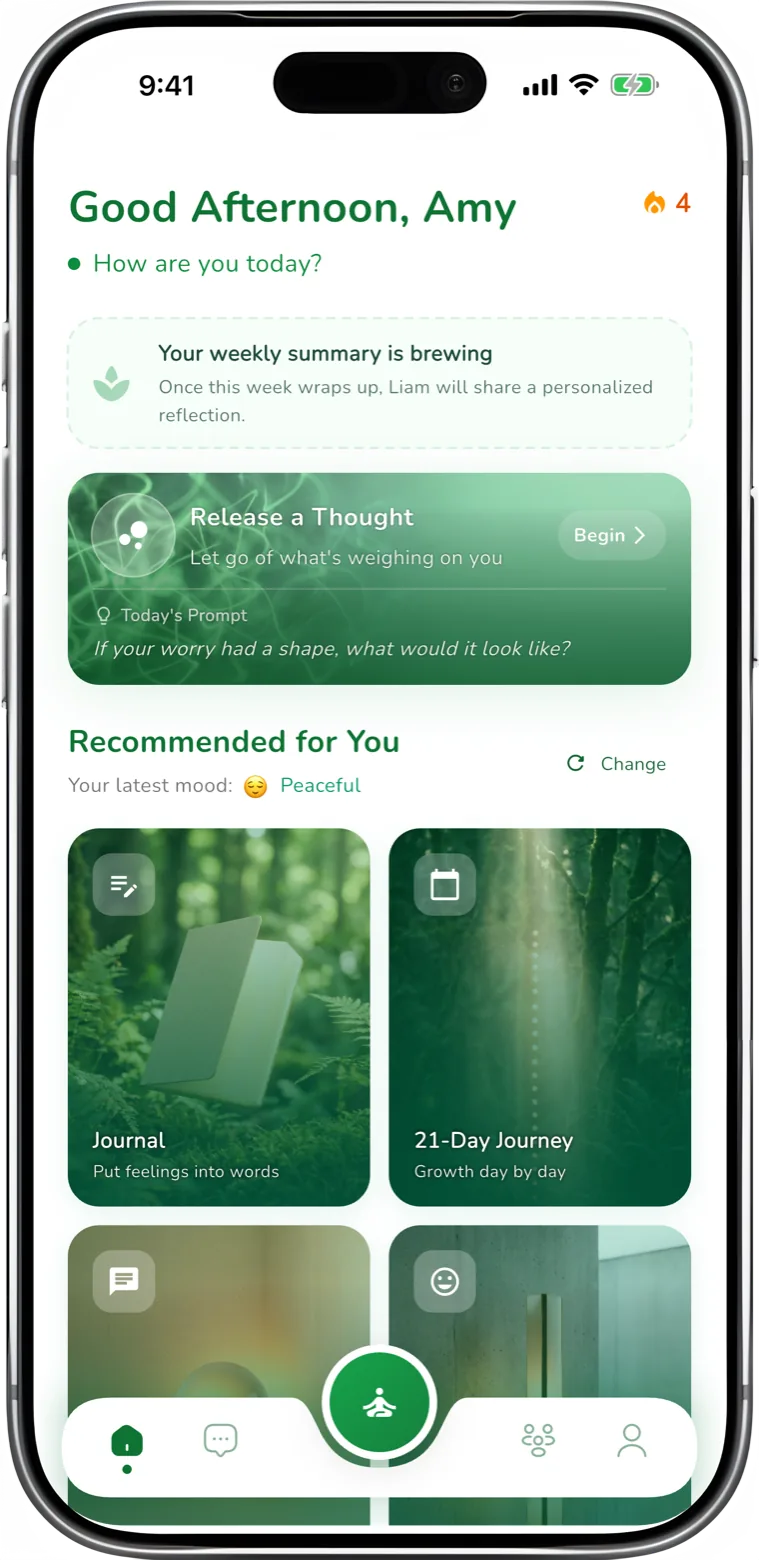
The home screen asks how you are, suggests one technique for right now and keeps the Journal, the 21-Day Journey and Liam one tap away.
Read this first: relif is our app
We build relif. A vendor comparison written by the vendor is worth exactly as much as its willingness to say where it loses, so this page does that in every section, and every claim about relif links to the feature page that backs it. Check each competitor’s own site before you decide. Competitor details were checked on 3 September 2026. We do not publish star ratings or review counts for any app on this page, ours included — they move weekly and they are not what should decide this.
The comparison at a glance
| Feature | Primary focus | Free tier | Paid price | Maturity |
|---|---|---|---|---|
| Calm | Meditation, sleep stories, music | A small rotating selection | Subscription; check the store | The largest app in the category |
| Headspace | Structured meditation courses, sleep, movement | Limited trial content | Subscription; check the store | Long-established, very widely used |
| Rootd | Panic attacks — one big button | Core panic tool | Subscription; check the store | Established in its niche |
| DARE | One method: Defuse, Allow, Run toward, Engage | Sample audios | Subscription; check the store | Established, smaller audience |
| MindShift CBT | CBT tools, from a non-profit (Anxiety Canada) | Everything — no subscription | Free | Smaller, non-profit distribution |
| Wysa | AI chatbot with CBT-style exercises; clinical and employer channels | Chat plus a subset of tools | Subscription; check the store | Mid-sized, plus institutional deployments |
| relif (ours) | 20+ relief techniques, breathing, AI companion, mood, journals | Unlimited breathing, 3 techniques/day, 5 AI messages/day | From $14.99/month, $107.99/year (US list) | New — the smallest audience here |
Table scrolls sideways on small screens.
Calm — best if you want a library to fall asleep to
Calm is the largest app in this category by a wide margin, and its catalogue depth is real: sleep stories, music, long-form meditation, celebrity narration. If what you want at 11pm is something soothing to listen to, Calm is very good at that and relif is not trying to compete.
Where it is a weaker fit: Calm is built around scheduled practice, not around the ninety seconds when your chest tightens in a meeting. There is no conversational companion, and the free tier is thin. Full relif vs Calm comparison.
Headspace — best if you want structure and published research
Headspace teaches meditation properly, in courses, with a coherent progression. It also publishes a research library citing peer-reviewed studies on its own content. relif has no clinical trial of its own and no published research on the relif app, so on that specific dimension Headspace is straightforwardly ahead and we are not going to pretend otherwise.
Where it is a weaker fit: it is a mindfulness product first. If the thing you need is a grounding script and a paced-breathing timer at 3am, the course structure is friction. Full relif vs Headspace comparison.
Rootd — best if panic attacks are the whole problem
Rootd does one thing with unusual clarity: a single large button that takes you straight into a panic-attack walkthrough. For someone whose primary experience is discrete panic episodes, that focus is a genuine advantage over any app with a home screen full of options.
Where it is a weaker fit: it is narrow by design. There is no AI companion, no journaling suite and no multi-week programme. Full relif vs Rootd comparison, and what people do during a panic attack.
DARE — best if you want one method, taught well
DARE teaches a single response to anxiety in four steps — Defuse, Allow, Run toward, Engage — built on the idea of moving toward the sensation instead of fighting it. Learning one method thoroughly beats sampling twenty, and DARE’s audio coaching is well made.
Where it is a weaker fit: if that particular framing does not click for you, there is not much else in the app. Full relif vs DARE comparison.
MindShift CBT — best if you want free, and you want CBT
MindShift CBT is published by Anxiety Canada, a non-profit, and it is free with no subscription. That is a stronger free offer than relif’s: relif is free to download and genuinely usable daily, but its journeys, reframing flow and two of its three journals sit behind Premium. If cost is the deciding factor and you want structured CBT tools, MindShift is the honest recommendation.
Where it is a weaker fit: no AI companion, a smaller technique library, and only English and French.
Wysa — best if institutional credibility matters to you
Wysa is the most clinically credentialled app in this list. It holds an FDA Breakthrough Device designation, and it is deployed through health systems and employers. Read that designation carefully, though: the FDA is explicit that the programme “speed[s] up development, assessment, and review” and that devices “must meet the FDA’s rigorous standards for device safety and effectiveness in order to be authorized for marketing”. Designation is a fast lane, not a clearance or approval.
Where relif differs: memory across conversations, eight languages with full right-to-left support, and a technique library alongside the chat rather than mostly inside it. Full relif vs Wysa comparison.
relif — best if you want tools for the moment, plus something to talk to
relif is built around anxious moments rather than scheduled sessions. It ships 20+ guided relief techniques across breathwork, grounding, affirmations, calming sound and bilateral audio, EMDR-inspired eye movement and somatic regulation; a breathing exercise with phase-synced haptics that works offline; mood check-ins with a 0–100 wellness score; three journals; three 21-day audio journeys; and Liam, an AI companion that remembers your triggers between conversations. Eight languages, Hebrew and Arabic included, right-to-left from the start.
Pick something else if: you mainly want sleep content (Calm), you want published research on the app itself (Headspace, Wysa), you need it to cost nothing (MindShift CBT), or you want one method taught deeply rather than a toolkit (DARE). relif is also new, with by far the smallest user base here, and its relief techniques and AI chat both require an internet connection.
How to choose in two minutes
- Discrete panic episodes? Rootd, or relif’s panic-attack techniques.
- Can’t sleep for worry? Calm for the library, relif for night-time technique work.
- Zero budget? MindShift CBT.
- Want something to talk to? Wysa or relif — both AI, neither a therapist.
- Not in English? relif ships eight languages with right-to-left support; most of this list does not.
None of these apps treats an anxiety disorder, and none of them replaces care. The National Institute of Mental Health’s overview of anxiety disorders is a good starting point if the worry is persistent, and our evidence page sets out what the research does and does not support.
Questions people ask before choosing
Which anxiety app is completely free?
MindShift CBT, from the non-profit Anxiety Canada, is free with no subscription. relif is free to download and usable every day — unlimited guided breathing, three relief techniques and five messages to Liam per day on a free account — but journeys, reframing and two journals require Premium.
Do any of these apps treat anxiety disorders?
No. These are wellness and self-care apps. They are not medical devices, they do not diagnose or treat any condition, and they do not replace professional care. If anxiety is affecting your daily life, speak to a qualified healthcare professional.
Is an AI companion safe to use for anxiety?
AI companions are not therapists and can be wrong. Evidence for the category is early and short-term — see the evidence page. Look for apps that disclose the AI clearly, route crisis language to real helplines rather than generating advice, and let you delete what the system remembers.
How current is this comparison?
Competitor details were checked on 3 September 2026 and their pricing changes often, so we point at the stores rather than printing prices we cannot keep current. relif’s own prices are on the pricing page.
Keep reading
- relif vs CalmMeditation breadth against anxiety-specific tools, side by side.
- relif vs HeadspaceWhere Headspace is genuinely stronger, and where relif is.
- relif vs WysaTwo AI companions on memory, languages, tools and price.
- Pricing: free and PremiumWhat the free tier includes, what Premium adds, and the cancellation terms.
Get relif free
Free to download on iOS and Android


Wellness Disclaimer: relif is a wellness and self-care companion designed to support your emotional wellbeing. It is not a medical device, does not provide medical advice, and is not a substitute for professional healthcare, therapy, or counseling. If you are experiencing a medical or mental health emergency, please contact your local emergency services or a crisis helpline immediately.
Editorial policy: Written by the relif team from primary sources — the product itself, store listings and peer-reviewed or official publications. Not medical advice. Read our editorial policy and sources.
Sources
- Breakthrough Devices Program — designation is not clearance or approval — U.S. Food and Drug Administration (2026)
- Anxiety Disorders — overview and when to seek help — National Institute of Mental Health (NIH) (2026)