Feature
Three journals: gratitude, achievements, free flow
relif has three journals: gratitude (15 prompts, free with an account), achievements (8 prompts across 6 categories, Premium) and free flow (10 rotating prompts, Premium). All auto-save as you type. Journaling has real research behind it — and a caveat most apps leave out.
Last reviewed:
Write it down, then let it go
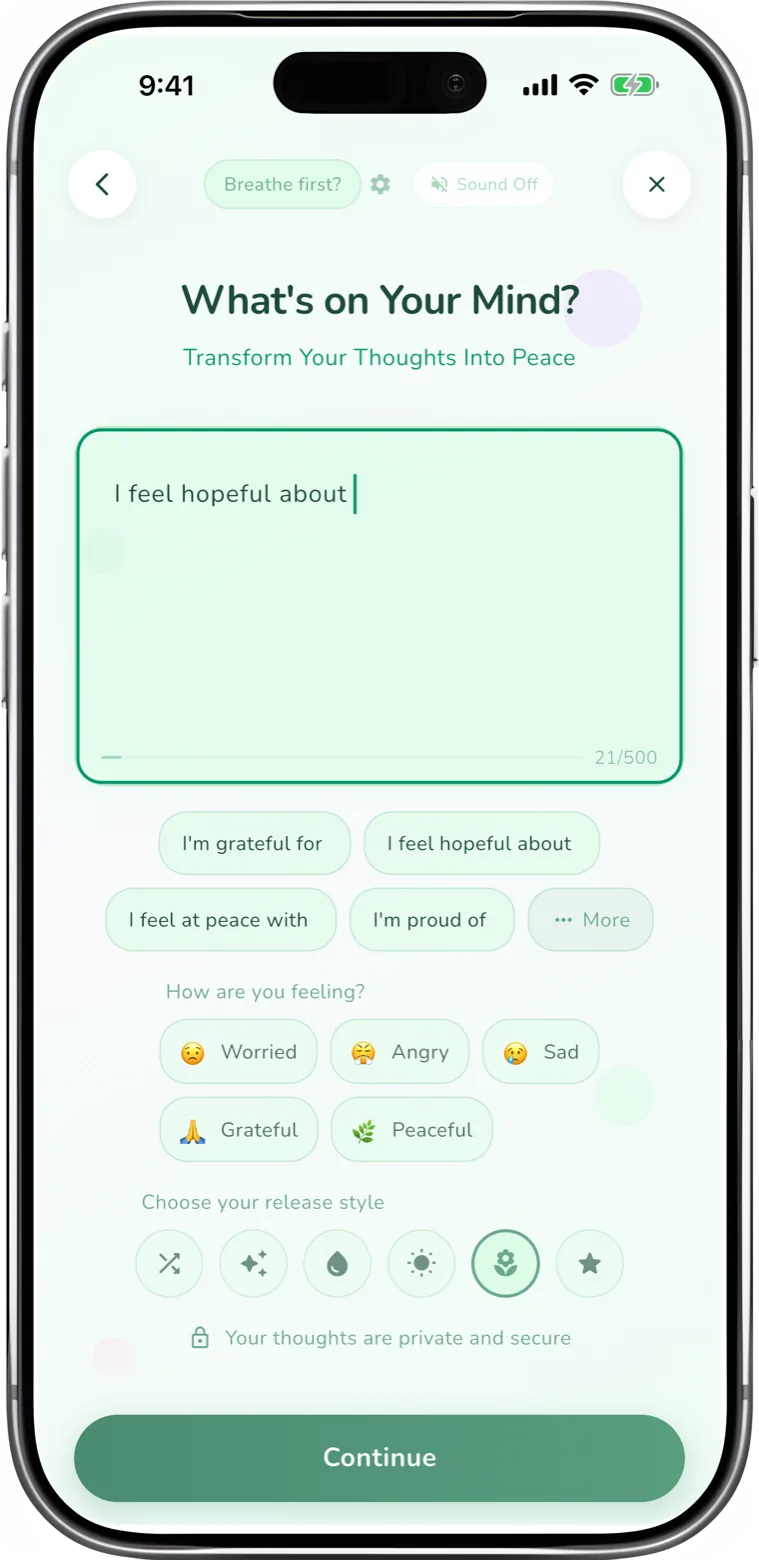
Thought Release gives a worry somewhere to land: type it, look at it, and release it.
The three journals
- Gratitude Journal — “notice the good”. Fifteen rotating prompts, up to ten entries a day, with an optional photo. Available on a free account.
- Achievement Journal — “celebrate your wins”. Eight prompts across six categories: personal, work, love, social, learning and creative. Up to ten entries a day. Premium.
- Free Flow Journal — write without structure. Ten prompts rotate every few seconds if a blank page is harder than a question, and you can ignore all of them. One entry a day. Premium.
Everything auto-saves after a two-second pause, so nothing is lost if you close the app mid-sentence. Journaling is unavailable without an account.
Which journal is on which tier
| Feature | No account | Free account | Premium |
|---|---|---|---|
| Gratitude Journal | Not available | Up to 10 entries a day | Up to 10 entries a day |
| Achievement Journal | Not available | Not included | Up to 10 a day |
| Free Flow Journal | Not available | Not included | 1 entry a day |
| Photos | — | Gratitude entries only | Gratitude entries only |
| Auto-save | — | Yes | Yes |
Table scrolls sideways on small screens.
What the research says — including the part apps skip
The expressive-writing paradigm developed by James Pennebaker asks people to write about a difficult experience for 15–20 minutes across three to five sessions. Baikie and Wilhelm’s 2005 review in Advances in Psychiatric Treatment catalogues the reported outcomes: fewer stress-related medical visits, improved immune and lung function, better mood, reduced depressive symptoms, and fewer intrusion and avoidance symptoms.
The caveat matters as much as the finding. The same review states that psychological benefits “are not as robust or as consistent as those for physical health”, that results vary widely across clinical groups, and that writing about something painful often makes people feel worse immediately afterwards before any longer-term benefit appears. If an entry leaves you feeling worse, that is a documented short-term effect, not a sign you did it wrong — and it is a good reason not to do deep trauma writing right before bed.
relif’s journals are deliberately lighter than the classic protocol: short, prompt-led, gratitude- and wins-oriented. That is gentler, and also less studied. Full context on the evidence page.
At a glance
- Journal types
- 3 — gratitude, achievements, free flow
- Prompts
- 15 gratitude, 8 achievement, 10 free-flow (rotating)
- Daily limits
- 10 gratitude, 10 achievement, 1 free flow
- Free tier
- Gratitude only, with an account
- Auto-save
- After a 2-second pause
- Photos
- Gratitude entries only
- Storage
- Journal entries are stored unencrypted — see the privacy page
Journaling versus Thought Release
Journals are for keeping something. Thought Release is for the opposite: you type a thought, pick a mood tag, and watch it dissolve in one of five animations — particles, a water ripple, ascending light, drifting petals or a star constellation. The thought is then shared anonymously to a seven-day community garden, where the only response anyone can give is a single positive reaction rendered as “others feel this too”, never a count. Three a day on a free account.
A word on storage
Journal entries are stored unencrypted, protected by per-user access rules rather than encryption at rest. Only chat messages, chat bookmarks, Liam’s memory and Thought Reframe answers are encrypted before storage. If that matters to what you were planning to write, it should factor into the decision — the full list is on the privacy page.
Common questions
Does journaling help with anxiety?
The expressive-writing literature reports mood and health benefits, with psychological effects less consistent than physical ones and an initial dip in how you feel. That is evidence for the practice, not for this app, and relif makes no outcome claim.
Which journal is free?
The gratitude journal, with a free account. The achievement and free-flow journals are Premium, and journaling is not available anonymously. See pricing.
Can I write in my own language?
Yes. relif ships in eight languages with full right-to-left layout for Hebrew and Arabic, and the prompts are localised.
Can I export my journal?
Yes — the app provides a data export, and full account deletion. Both are described in the privacy policy.
Keep reading
Get relif free
Free to download on iOS and Android


Wellness Disclaimer: relif is a wellness and self-care companion designed to support your emotional wellbeing. It is not a medical device, does not provide medical advice, and is not a substitute for professional healthcare, therapy, or counseling. If you are experiencing a medical or mental health emergency, please contact your local emergency services or a crisis helpline immediately.
Editorial policy: Written by the relif team from primary sources — the product itself, store listings and peer-reviewed or official publications. Not medical advice. Read our editorial policy and sources.
Sources
- Emotional and physical health benefits of expressive writing — Advances in Psychiatric Treatment (Baikie & Wilhelm) (2005)