Feature
Liam, the AI companion inside relif
Liam is the AI companion inside relif, a free anxiety and stress app for iOS 15 and later and Android 8.0 and later. Liam is an AI, not a therapist or counsellor: it responds to what you write, suggests breathing or grounding exercises, remembers your triggers between conversations, and speaks all eight app languages.
Last reviewed:
Liam, the AI companion
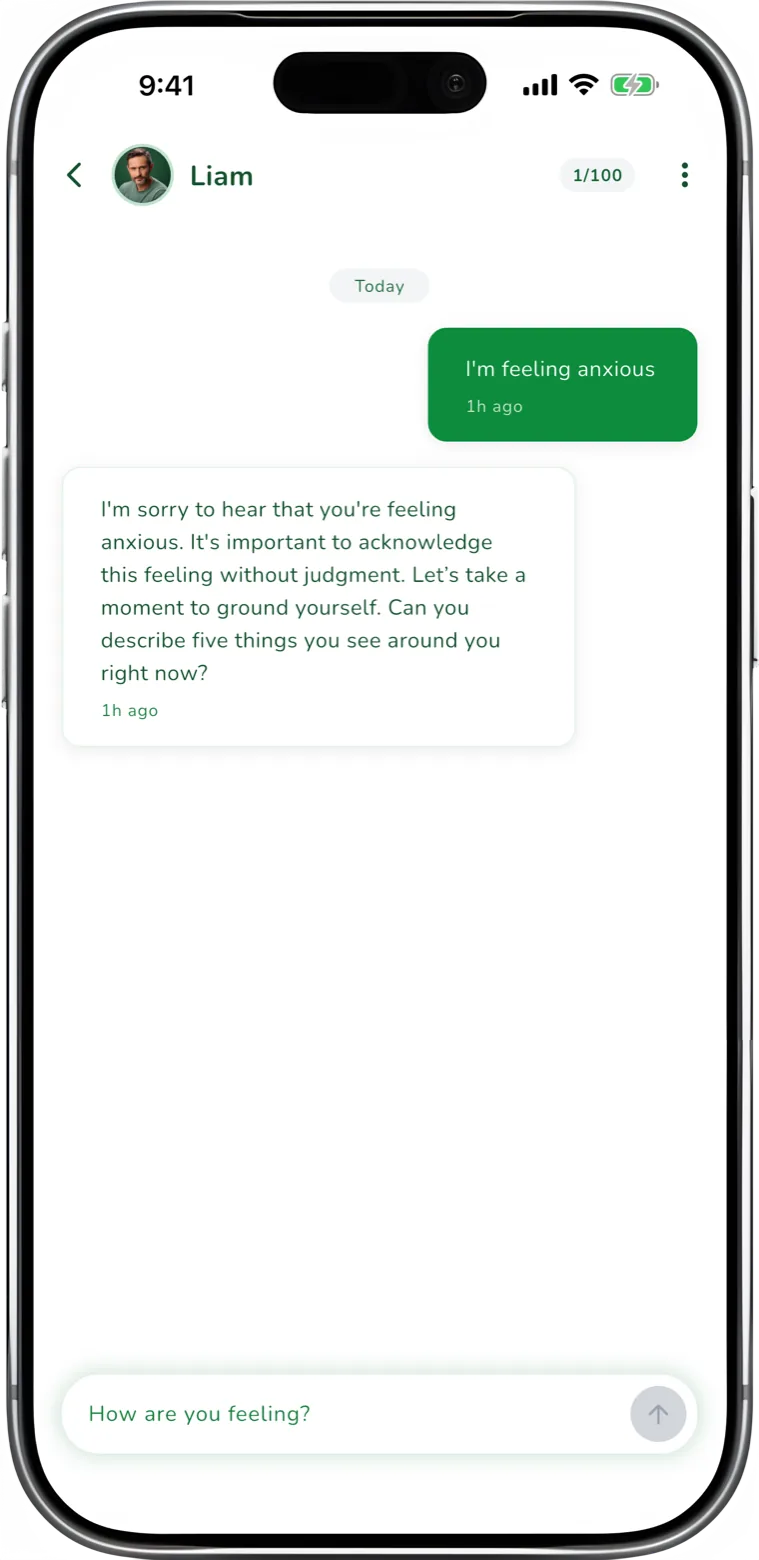
Liam listens, asks one question at a time and suggests a technique when you want one. Liam is an AI companion, not a therapist.
What Liam is, and what it is not
Liam is a conversational AI built into relif. You type; Liam replies in text, asks a question back, or offers an exercise you can start in one tap. There is no waiting room, no session booking and no human on the other end — because there is no human on the other end. A non-dismissible banner sits above every conversation in the app saying exactly that: “AI companion · Not a substitute for professional help.”
Liam is not a therapist, counsellor or psychologist. It does not diagnose, treat or prescribe, it does not score your mental health, and it is not a medical device. relif treats Liam as a limited-risk AI system under Article 50 of the EU AI Act, which is why the disclosure appears before you can send a message rather than buried in settings.
How Liam works
Liam runs on a fine-tuned OpenAI language model. The fine-tune combined supervised training on 710 curated examples across all eight app languages — drawing on ten therapy-book frameworks — with 106 preference pairs used for preference tuning, so replies land closer to a calm, non-clinical register than a stock assistant does. Every request is proxied through relif’s Cloud Functions backend; no API key ships inside the app.
Liam adapts its length and tone to three stress states — calm, mild and high. In a high-stress state it gets shorter and more concrete, and is more likely to hand you straight to a guided breathing exercise than to keep talking. On the conversation itself you get bookmarks, eight preset tags, pinning, AI-generated titles and full-text search across your history, up to ten saved conversations.
What Liam remembers — and how to delete it
Liam carries memory across conversations. It can retain the triggers you have mentioned, which techniques you said helped, whether you prefer short or longer replies, the kind of worry you tend to bring, and the time of day you usually open the app. That is the difference between explaining yourself from scratch every time and picking up where you left off.
Everything Liam remembers is visible to you in a dedicated memory screen inside the app, and every item can be deleted individually. That screen exists specifically to satisfy the GDPR’s right to erasure (Article 17). Deleting a memory removes it from what Liam sees next time.
What happens when a message sounds like a crisis
Before a reply is generated, relif screens the message for crisis language in all eight languages, with negation analysis so “I’m not going to hurt myself” is not treated as a disclosure. If the check fires, the resources you see are never written by the AI — they come from a hard-coded registry of verified helplines covering more than thirty countries, with a directory fallback everywhere else.
Four more layers sit around the model:
- Your message is isolated inside the prompt so it cannot be used to rewrite Liam’s instructions.
- Structured output schemas constrain replies where a strict shape is required.
- A post-generation filter screens every reply for phone numbers, diagnoses, medication advice, self-harm content and data leaks before it reaches you.
- If any layer fails, a locale-aware fallback message is shown instead of a generated one.
Crisis-detection events are logged for accountability under California SB 243, but the audit record stores a SHA-256 hash of the matched keyword and metadata — never the text of your message. There is also a cumulative three-hour break reminder for minors. Crisis screens are rendered in lavender, not red, because a red alert is the last thing a frightened person needs. More detail on the crisis support page.
Privacy: what is encrypted, and what that does not mean
Chat messages and their previews, chat bookmarks, Liam’s memory and your Thought Reframe answers are encrypted with AES-256 before they are written to the database. Data is encrypted in transit. Two honest caveats, because the alternative is marketing that does not survive inspection:
- If encryption fails, the app retries once and then saves the message unencrypted rather than losing it. So “every message is always encrypted” would be an overstatement.
- The encryption key is derived server-side, not held only on your phone. relif is therefore technically able to decrypt chat messages — for example, in response to a lawful request. That is why this page does not say “zero-knowledge”, “military-grade” or “your words never leave your device”.
Your messages are sent to OpenAI to generate a reply. The full picture is on the privacy and security page and in the privacy policy.
Message limits, by tier
| Feature | No accountanonymous | Free account | Premium |
|---|---|---|---|
| Messages to Liam | 2 in total | 5 per day | 100 per day |
| Chat history and search | Not available | Full | Full |
| Cross-conversation memory | Not available | Full | Full |
| Weekly reflection from Liam | Not available | Snapshot and stats, 4 weeks of history | Narrative reflection, correlations, 12 weeks |
| Crisis detection | Always on | Always on | Always on |
Table scrolls sideways on small screens.
Premium is 100 messages a day, not unlimited — the app store copy that says “unlimited” overstates it, and we would rather you knew the number. Prices, trial terms and what else Premium unlocks are on the pricing page.
Eight languages, culturally adapted
Liam speaks English, Hebrew, Arabic, German, Spanish, French, Portuguese and Russian, with full right-to-left layout in Hebrew and Arabic. The adaptation goes past translation: prompt instructions differ per locale, and Liam’s Weekly Reflection is delivered the day after the cultural week ends — Sunday for Hebrew, Saturday for Arabic, Monday everywhere else.
At a glance
- What it is
- An AI companion in a wellness app. Not a therapist, not a medical device.
- Model
- A fine-tuned OpenAI language model, proxied through relif’s backend
- Languages
- English, Hebrew, Arabic, German, Spanish, French, Portuguese, Russian
- Platforms
- iOS 15.0 or later, Android 8.0 (API 26) or later
- Free tier
- 2 messages without an account, 5 a day with a free account
- Premium
- 100 messages a day, from $14.99/month (US App Store list price)
- Memory
- Cross-conversation; viewable and deletable item by item
- Needs a connection
- Yes — chat does not work offline
Does talking to an AI actually help?
For the category, there is early evidence. A 2023 systematic review and meta-analysis in npj Digital Medicine pooled 15 randomised controlled trials covering 1,744 participants and found AI-based conversational agents improved depression (Hedge’s g 0.64, 95% CI 0.17–1.12) and psychological distress (g 0.70, 95% CI 0.18–1.22). The same review is candid about the ceiling: with only six studies reporting follow-up, “the lasting effects of CA interventions remain unclear”.
That is evidence about conversational agents as a category, not about Liam. relif has run no clinical trial, holds no regulatory clearance, and makes no claim that Liam reduces anxiety. The full picture, including what the research does not show, is on the evidence page.
Common questions about Liam
Is Liam a real person?
No. Liam is an AI. Replies are generated by a language model and may be wrong. relif tells you this in the app before your first message and keeps a banner on screen for every conversation.
Can I use Liam without an account?
Yes — you get two messages without giving an email address, then a free account raises it to five a day. Being able to use relif anonymously is deliberate.
Does Liam work offline?
No. Chat needs a connection, and so do the relief techniques. Guided breathing works offline, and you can still complete a Thought Release ritual, though it will not reach the community garden until you reconnect.
What happens to the things I tell Liam?
Your messages are encrypted before storage and sent to OpenAI to generate replies. You can view and delete Liam’s memory, and you can export or delete your whole account from inside the app. Read the privacy page for the parts that are not encrypted.
Can Liam help in an emergency?
No. Crisis detection needs a connection and it is not a monitoring service. If you are in danger, contact your local emergency services or a crisis line — the numbers are at the bottom of this page.
Keep reading
- The evidence behind the techniquesWhat the research says about AI-delivered support, paced breathing and reframing — with limits.
- relif vs WysaTwo AI companions compared on memory, languages, tools and price.
- Privacy and security in relifExactly which four surfaces are encrypted before storage, and which are not.
- Crisis support in the appHow crisis language is detected and routed to verified helplines.
Meet Liam
Free to download on iOS and Android


Wellness Disclaimer: relif is a wellness and self-care companion designed to support your emotional wellbeing. It is not a medical device, does not provide medical advice, and is not a substitute for professional healthcare, therapy, or counseling. If you are experiencing a medical or mental health emergency, please contact your local emergency services or a crisis helpline immediately.
Editorial policy: Written by the relif team from primary sources — the product itself, store listings and peer-reviewed or official publications. Not medical advice. Read our editorial policy and sources.
Sources
- Systematic review and meta-analysis of AI-based conversational agents for promoting mental health and well-being — npj Digital Medicine (Li, Zhang, Lee, Kraut & Mohr) (2023)
- Article 50 — Transparency obligations for providers and deployers of certain AI systems — Regulation (EU) 2024/1689 (EU AI Act) (2024)