Feature
Guided breathing, paced by vibration
relif’s breathing exercise gives you four presets — 4-7-8, box, quick calm and coherent breathing — plus unlimited custom patterns, an animated pacer, and vibration that changes with each phase so you can follow it without looking. It is unlimited on every tier, free, and works offline.
Last reviewed:
Guided breathing, one count at a time
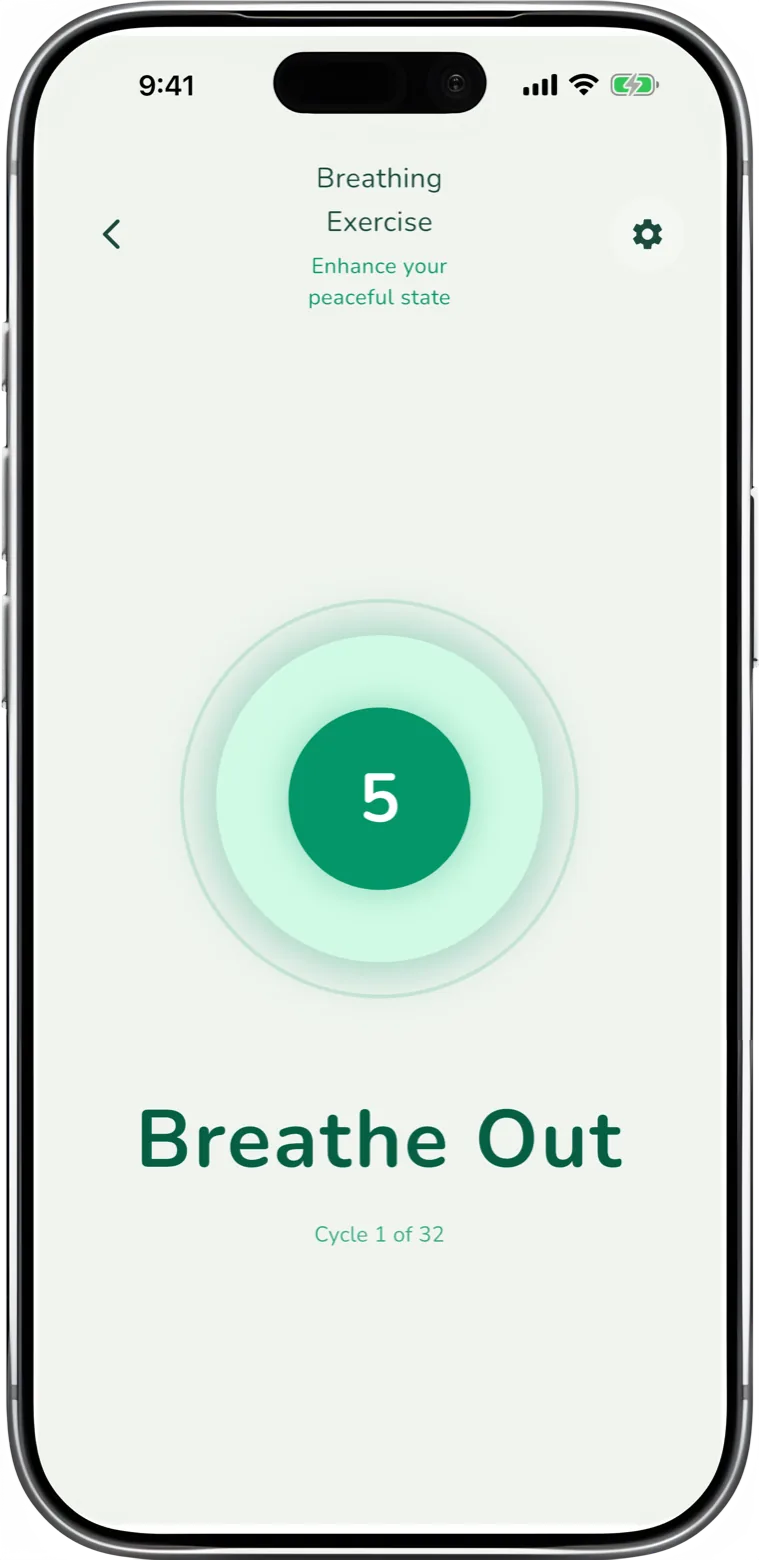
A single expanding circle paces each inhale, hold and exhale, so you can follow along without reading anything.
The four presets
Each preset is a fixed inhale / hold / exhale pattern. The circle on screen expands and contracts in time with it, the phase label reads “Breathe In”, “Hold” or “Breathe Out”, and the phone vibrates at each transition.
| Feature | Inhale | Hold | Exhale | One cycle |
|---|---|---|---|---|
| 4-7-8 Relaxation | 4s | 7s | 8s | 19s |
| Box Breathing | 4s | 4s | 4s | 12s |
| Quick Calm | 3s | 3s | 3s | 9s |
| Coherent Breathing | 5s | none | 5s | 10s |
Table scrolls sideways on small screens.
Custom patterns
You can build your own: inhale from 1 to 10 seconds, hold from 0 to 10, exhale from 1 to 10 (the exhale must be at least as long as the inhale), and anywhere from 1 to 100 cycles. Saved patterns sit alongside the presets under Presets, Favorites and Custom tabs. There is no cap on how many custom patterns you keep.
The exhale-at-least-as-long-as-the-inhale rule is deliberate. Exhale-weighted patterns are the ones with the strongest supporting literature, and letting someone build a 10-second inhale with a 1-second exhale would be building a hyperventilation trainer.
Why the vibration matters
The haptic pulse tracks the phase, so the exercise works with the screen face-down, in a pocket, in a meeting or in the dark at 3am. That is the practical difference between a breathing feature you use when you have privacy and one you use when you do not. It is also the accessible path: you can follow the pace without watching an animation.
It works offline, and it is free
Guided breathing is available on every tier — anonymous, free account and Premium — with no daily cap, and it runs without an internet connection. That is unusual in this app: relif’s AI chat and its 20+ guided relief techniques both require a connection, and we say so rather than claiming the app “works offline” in general.
At a glance
- Presets
- 4 — 4-7-8, box, quick calm, coherent
- Custom patterns
- Unlimited; inhale 1–10s, hold 0–10s, exhale 1–10s, 1–100 cycles
- Guidance
- Animated pacer, phase labels, vibration synced to each phase
- Cost
- Free, unlimited, on every tier including without an account
- Offline
- Yes
- Platforms
- iOS 15.0 or later, Android 8.0 (API 26) or later
- Also in the technique library
- 9 breathwork techniques, including the physiological sigh and 7-11 breathing
The breathwork techniques are a separate surface
Alongside the breathing exercise, relif’s relief-technique library contains nine breathwork techniques with audio and video guidance — including the psychological sigh (a double inhale and a long exhale), 7-11 breathing, 4-8 extended exhale and shorter 3-3 and 3-3-3 patterns. Those are guided sessions and need a connection; the breathing exercise above is the offline pacer. Do not confuse the two counts: four presets, nine guided breathwork techniques.
What the research supports
Slow, exhale-weighted breathing is the best-evidenced category in relif. A 2023 randomised study in Cell Reports Medicine had 108 participants practise five minutes daily for 28 days; the cyclic-sighing group showed greater mood improvement and a larger reduction in respiratory rate than a mindfulness-meditation comparison group. A 2018 systematic review in Frontiers in Human Neuroscience concluded that slow breathing techniques “act enhancing autonomic, cerebral and psychological flexibility”.
Both studies involved healthy volunteers doing daily practice, and neither tested a phone app or an acute anxious episode. The NIH also notes that relaxation techniques, while “generally considered safe for healthy people”, occasionally increase anxiety and warrant caution for people with epilepsy, certain psychiatric conditions or a trauma history. The full picture, including what these studies do not establish, is on the evidence page.
Questions about breathing exercises
Which breathing pattern should I start with?
Coherent breathing (5 in, 5 out) is the gentlest place to start because there is no hold. 4-7-8 is popular for winding down. If a long hold makes you uncomfortable, skip it — discomfort is a reason to change the pattern, not to push through.
Do I need an account or a subscription?
Neither. Guided breathing is unlimited without an account and without paying, and it works offline. The gated features are listed on the pricing page.
Does breathing help during a panic attack?
It is one of the things people commonly do, and slow exhale-weighted breathing has supporting research as a daily practice. No breathing pattern reliably stops a panic attack, and we do not claim one does. See panic attacks.
Can I use it without looking at the screen?
Yes — that is what the phase-synced vibration is for. Start the pattern, put the phone face-down or in your pocket, and follow the pulses.
Keep reading
- The evidence behind the techniquesThe Stanford cyclic-sighing trial, the slow-breathing review, and what they do not show.
- Panic attacks: what people do in the momentWhere exhale-weighted breathing fits when something is happening now.
- Anxiety at nightUsing longer exhales as part of a wind-down.
- PricingWhy breathing stays unlimited on the free tier.
Get relif free
Free to download on iOS and Android


Wellness Disclaimer: relif is a wellness and self-care companion designed to support your emotional wellbeing. It is not a medical device, does not provide medical advice, and is not a substitute for professional healthcare, therapy, or counseling. If you are experiencing a medical or mental health emergency, please contact your local emergency services or a crisis helpline immediately.
Editorial policy: Written by the relif team from primary sources — the product itself, store listings and peer-reviewed or official publications. Not medical advice. Read our editorial policy and sources.
Sources
- Brief structured respiration practices enhance mood and reduce physiological arousal — Cell Reports Medicine (Balban et al.) (2023)
- How Breath-Control Can Change Your Life: A Systematic Review on Psycho-Physiological Correlates of Slow Breathing — Frontiers in Human Neuroscience (Zaccaro et al.) (2018)
- Relaxation Techniques: What You Need To Know — National Center for Complementary and Integrative Health (NIH) (2026)