Situation
Social situations: techniques people use before, during and after
Nerves before a presentation, a party or a difficult conversation are common. This page describes what people commonly do around social situations — slowing the breath beforehand, discreet grounding during, and interrupting the replay afterwards — and when persistent social fear is worth taking to a professional.
Last reviewed:
Write it down, then let it go
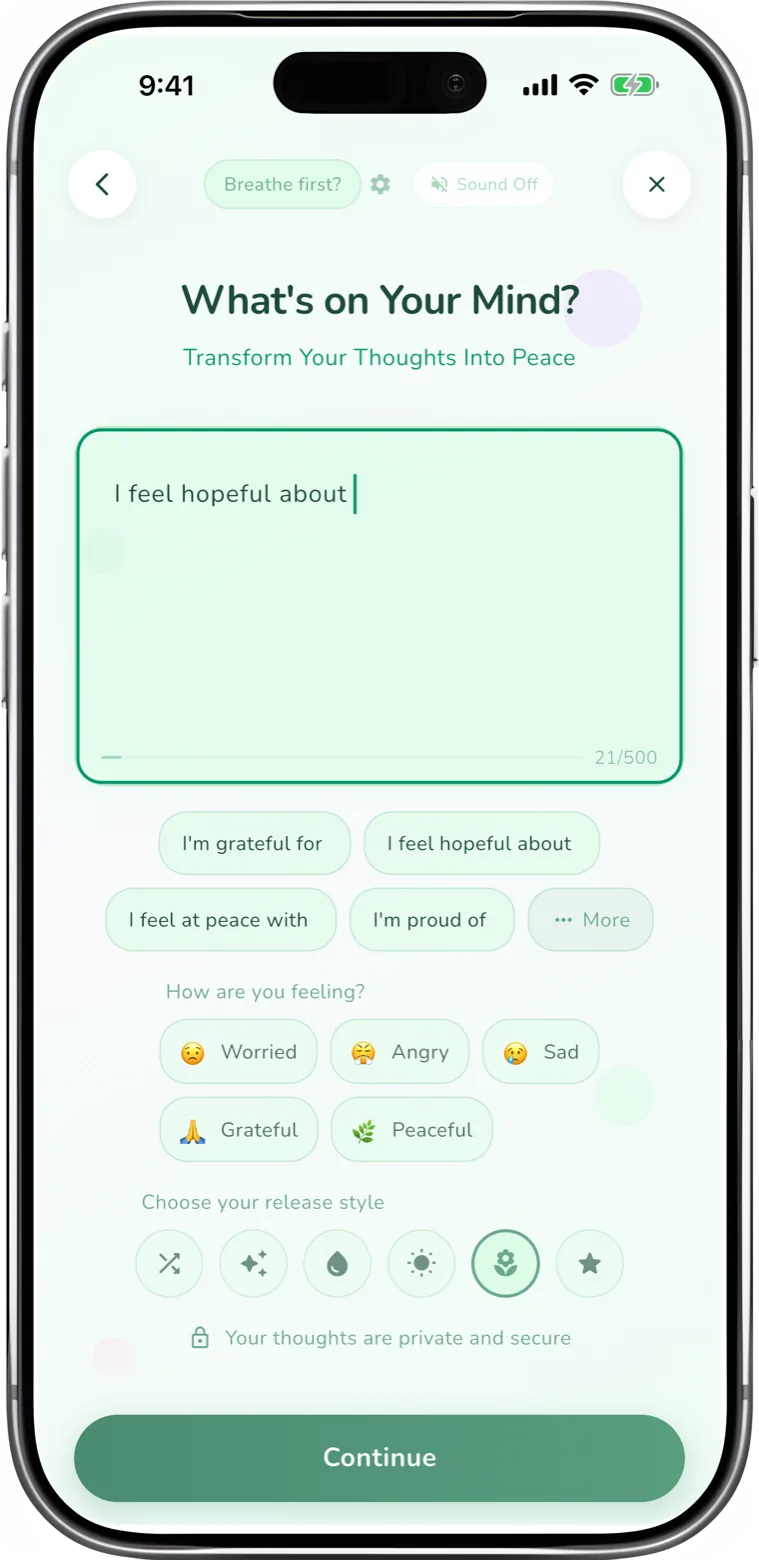
Thought Release gives a worry somewhere to land: type it, look at it, and release it.
What it tends to look like
Social anxiety is not shyness and it is not introversion. It usually has three parts: anticipation (rehearsing the event, imagining it going badly), the moment itself (self-monitoring, blushing, a shaky voice, losing your thread), and the post-mortem — replaying everything you said and cataloguing the parts that were embarrassing. The post-mortem is often the most costly part, because it can run for days on an event that lasted twenty minutes.
The National Institute of Mental Health lists social anxiety disorder among the main anxiety disorders. Being nervous before a presentation is not that. The distinction that matters clinically is persistence, intensity, and whether you have begun avoiding things because of it.
Before
- Slow the exhale. A few minutes of coherent breathing (5 seconds in, 5 out) or 4-7-8 before you go in gives you something to do with the waiting instead of rehearsing. relif’s breathing exercise vibrates in time with each phase, so you can run it in a corridor with the phone in your pocket.
- Decide one thing you want to do, not one outcome you want. “Ask two people a question” is inside your control; “be interesting” is not.
- Write down the specific prediction. Not “it’ll be awful” but “I will go blank and they will notice”. A specific prediction can be checked afterwards; a vague dread cannot.
During
- Move attention outward. Self-monitoring — tracking your own voice, hands and face — is what keeps the loop running. Naming three things in the room, or listening for the actual content of what someone is saying, competes with it.
- Ask a question. It moves the spotlight and it is easier than performing.
- Let the physical symptoms be there. Trying to force a blush or a shaky voice to stop generally adds a second layer of alarm on top of the first.
- Do not leave immediately. Escaping brings relief now and usually makes the same room harder next time. Staying a few minutes past the urge is the move therapists work on directly.
After: interrupting the replay
The post-event review deserves a technique of its own, because it is where most of the damage accumulates. Two that people use:
- Check the prediction you wrote down. Did the specific thing happen? If it did, was the consequence what you forecast?
- Reframe rather than relitigate. relif’s Thought Reframe walks eight questions in five to ten minutes — identify the thought, rate how much you believe it, test it against reality, consider its impact, try another perspective, then re-rate the belief. It is inspired by Byron Katie’s The Work, not a clinical CBT protocol, and it is a Premium feature.
- Write it down and close it. A short free-flow entry, or naming the thought in Thought Release and watching it dissolve, gives the replay an ending rather than letting it loop.
When to talk to someone
Consider a professional if fear of social situations is persistent, if it has changed what you do — turning down invitations, avoiding meetings, choosing a job or a course around it — or if the anticipation regularly costs you days. Cognitive behavioural therapy has among the strongest evidence bases in mental health, and Hofmann and colleagues’ review of 269 meta-analyses reported at least medium effect sizes for CBT in social anxiety disorder. That is therapist-delivered CBT. An app is not that.
What relif offers around social situations
relif is a free wellness app for iOS 15 and later and Android 8.0 and later, in eight languages. It does not treat social anxiety disorder. What it has for these moments:
- Overcoming Social Anxiety — one of three 21-day audio journeys, 10–15 minutes a day, described in the app as a soothing audio you listen to daily so the techniques become familiar. Premium.
- Affirmation techniques for social confidence, part of the 20+ relief techniques. Three a day on a free account.
- Guided breathing — unlimited, offline, silent with the screen off.
- Liam, an AI companion — an AI, not a therapist — to talk through the replay afterwards. It remembers the situations you have mentioned before.
Common questions
Is social anxiety the same as being shy?
No. Shyness is a temperament; social anxiety involves persistent fear of being judged, often with physical symptoms and avoidance. Social anxiety disorder is a clinical diagnosis, and only a professional can make it.
What can I do in the five minutes before I go in?
Slow, exhale-weighted breathing, and choosing one concrete action inside your control. relif’s breathing exercise is unlimited on the free tier, works offline, and paces you with vibration so you do not need to look at it.
How do I stop replaying the conversation afterwards?
You will not stop it on command. What helps is giving it a container — a written check of the specific prediction, a reframing exercise, or writing it down once and closing it, rather than reviewing it in fragments all evening.
Can an app fix social anxiety?
No, and relif does not claim to. It offers techniques and a record. For persistent social anxiety, the evidence points to therapy — see the evidence page.
Keep reading
- 21-Day JourneysThree guided audio programmes, including one built around social situations.
- Thought ReframeThe eight-step flow for the “everyone noticed” replay.
- Guided breathing in relifSilent, screen-off breathing you can do in a corridor.
- Anxiety at workMeetings, presentations and the desk-bound version of the same problem.
Get relif free
Free to download on iOS and Android


Wellness Disclaimer: relif is a wellness and self-care companion designed to support your emotional wellbeing. It is not a medical device, does not provide medical advice, and is not a substitute for professional healthcare, therapy, or counseling. If you are experiencing a medical or mental health emergency, please contact your local emergency services or a crisis helpline immediately.
Editorial policy: Written by the relif team from primary sources — the product itself, store listings and peer-reviewed or official publications. Not medical advice. Read our editorial policy and sources.
Sources
- Anxiety Disorders — including social anxiety disorder — National Institute of Mental Health (NIH) (2026)
- The Efficacy of Cognitive Behavioral Therapy: A Review of Meta-analyses — Cognitive Therapy and Research (Hofmann et al.) (2012)