Feature
Thought Reframe: eight questions for a stuck thought
Thought Reframe is relif’s structured way of working on a single stuck thought. It walks eight questions in five to ten minutes — name it, rate how much you believe it, test it, look at its impact, try another angle, then re-rate the belief. It is a Premium feature, and it is not therapy.
Last reviewed:
Write it down, then let it go
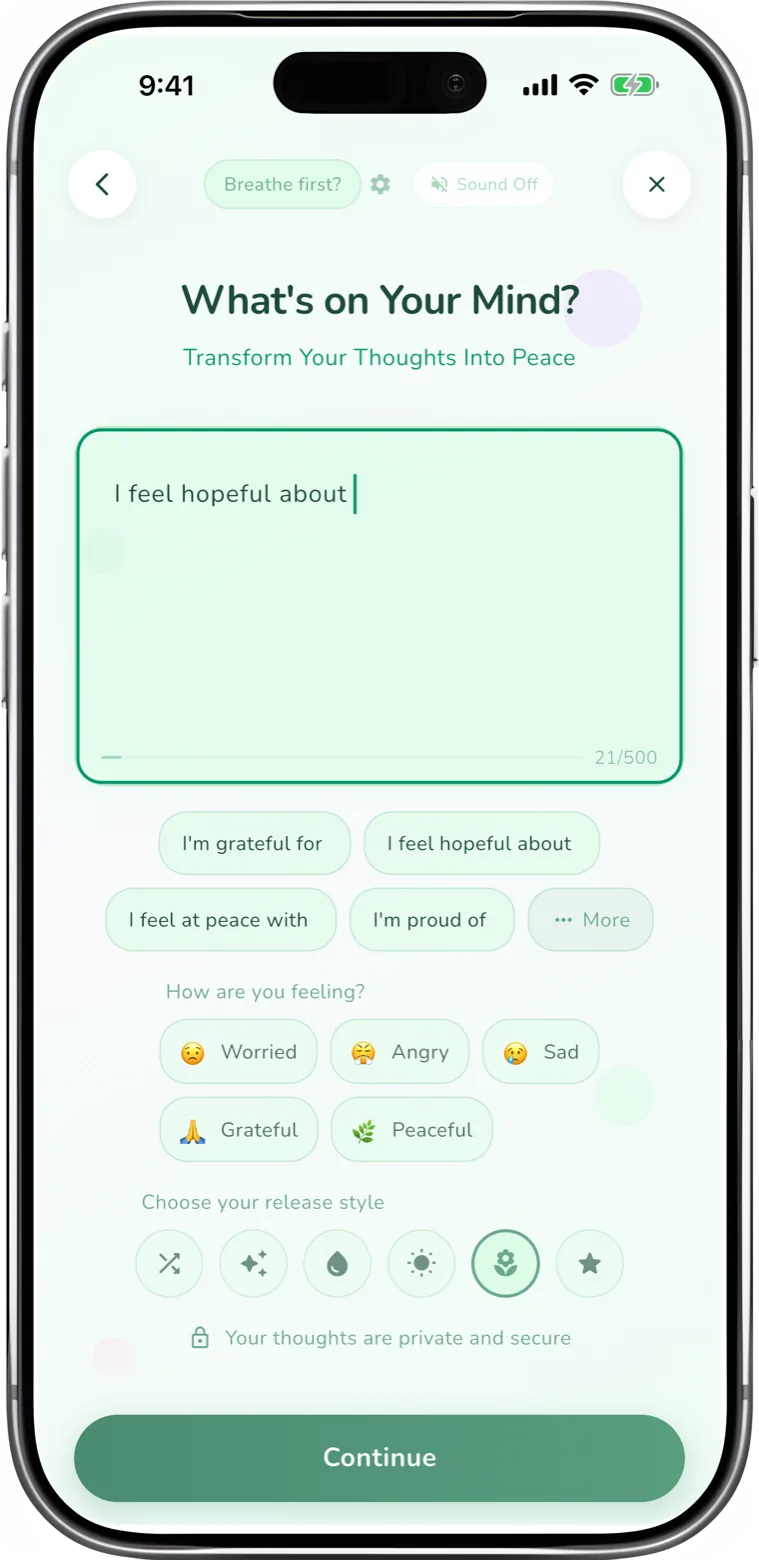
Thought Release gives a worry somewhere to land: type it, look at it, and release it.
The eight steps
In the app the coach marks describe it as “8 gentle questions”, with a quick-start option and an explicit “go at your pace”. You answer in your own words; nothing is scored.
- Identify. Write the thought as a single sentence, in the words you actually think it in.
- Belief. Rate how strongly you believe it right now, on a 0–100 slider.
- Reality check. What do you actually know? What is prediction rather than fact?
- Impact. What does holding this thought cost you — in mood, in what you do, in how you treat people?
- Perspective. How would this read to someone else, or to you in a year?
- Release. What would be different if you were not carrying it?
- Alternative. Write a version you could actually believe — not a slogan, something true.
- Update. Re-rate the original belief. Seeing the number move, or not move, is the point.
Most people take five to ten minutes. Sessions save as you go, so you can leave in the middle and come back.
Where the questions come from
The flow is inspired by Byron Katie’s The Work — examine the thought, ask what is actually true, notice what believing it does to you, then try the turnaround. It borrows the shape of cognitive restructuring, which is the mechanism at the centre of cognitive behavioural therapy.
It is not CBT, and we do not call it that. There is no clinician, no formal thought record, no homework review, and no enumerated list of cognitive distortions. The taxonomies relif tracks alongside your entries are lighter: emotional patterns such as rumination, avoidance, catastrophising, self-criticism, gratitude and acceptance, and key themes such as anxiety, relationships, self-worth, the future, the past, control and growth. Those are derived from keywords, not from a language model — no AI reads your reframing entries to categorise them.
What the evidence supports
Cognitive behavioural therapy has the strongest evidence base of any psychotherapy. Hofmann and colleagues reviewed 269 meta-analyses in 2012 and concluded the evidence base is “very strong”, with the most consistent results of all in anxiety disorders. That is evidence for therapist-delivered CBT. It is not evidence that an eight-question flow in an app produces the same result, and this page does not imply that it does. More on the distinction on the evidence page.
What happens to what you write
Thought Reframe responses are one of the four surfaces relif encrypts with AES-256 before storing — alongside chat messages, chat bookmarks and Liam’s memory. Journals and mood entries are not encrypted at rest, and we list that plainly on the privacy page rather than rounding it up to “all your data is encrypted”.
At a glance
- Steps
- 8, in a fixed order
- Time
- 5–10 minutes; saves as you go
- Lineage
- Inspired by Byron Katie’s The Work; not a CBT protocol
- Belief rating
- 0–100 slider, rated before and after
- Availability
- Premium only — not on the free tier
- Analysis
- Keyword-derived patterns and themes; no AI reads your entries
- Storage
- Encrypted with AES-256 before it is written
When it helps, and when it does not
It suits a single, specific, repeating thought — the sentence you have been arguing with all week. It is a poor fit for a diffuse mood with no sentence attached, and a poor fit mid-panic, when nobody can do structured cognitive work. In an acute moment, breathing or grounding is the right tool; reframing is for afterwards.
Common questions
Is Thought Reframe free?
No — it is a Premium feature, and it is not available on the free tier or without an account. The free tier includes unlimited breathing, three relief techniques a day, five messages to Liam, mood tracking and the gratitude journal. See pricing.
Is this CBT?
No. It borrows the shape of cognitive restructuring, but there is no clinician and no protocol. relif is a wellness app, not a treatment, and it does not deliver therapy.
Does an AI read what I write here?
No. The patterns and themes relif shows alongside your entries are derived by keyword matching, not by a language model. Liam only sees what you send Liam.
What if the belief rating does not move?
That is a legitimate outcome and the app does not treat it as a failure. Some thoughts are true and need action rather than reframing; some need more than eight questions.
Keep reading
Get relif free
Free to download on iOS and Android


Wellness Disclaimer: relif is a wellness and self-care companion designed to support your emotional wellbeing. It is not a medical device, does not provide medical advice, and is not a substitute for professional healthcare, therapy, or counseling. If you are experiencing a medical or mental health emergency, please contact your local emergency services or a crisis helpline immediately.
Editorial policy: Written by the relif team from primary sources — the product itself, store listings and peer-reviewed or official publications. Not medical advice. Read our editorial policy and sources.
Sources
- The Efficacy of Cognitive Behavioral Therapy: A Review of Meta-analyses — Cognitive Therapy and Research (Hofmann, Asnaani, Vonk, Sawyer & Fang) (2012)