Situation
Health worry and the checking loop
Health worry runs on a loop: notice a sensation, search it, feel briefly reassured, then notice something else. This page describes why checking and reassurance-seeking make the loop stronger, what people do instead, and when persistent health anxiety is worth taking to a doctor.
Last reviewed:
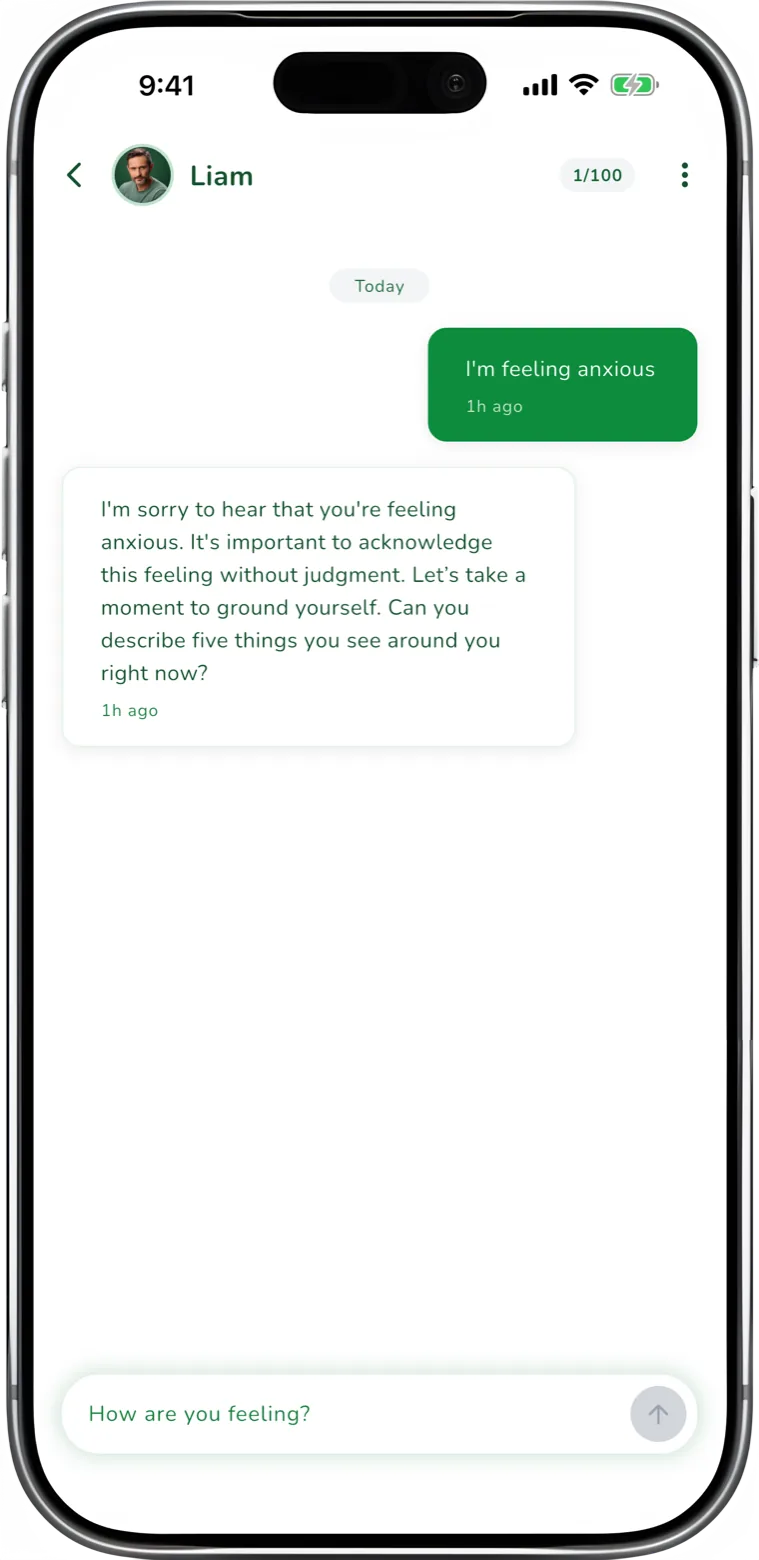
Liam, the AI companion
Liam listens, asks one question at a time and suggests a technique when you want one. Liam is an AI companion, not a therapist.
First, the thing this page cannot do
Nothing here can tell you whether a symptom is serious. If you have a new, changing or worsening symptom, get it assessed. Health anxiety and genuine illness are not mutually exclusive, and “it’s probably just anxiety” is a conclusion for a clinician to reach, not an article. This page is about the worry loop, not about your symptom.
Why the loop tightens
The pattern is consistent: you notice a sensation, you check — searching, scanning your body, asking someone for reassurance — and the checking produces relief. That relief is the problem. It teaches the loop that checking works, so the next sensation produces a stronger urge to check, and the relief gets shorter each time.
Body scanning also finds things. Everyone’s body produces a constant stream of twinges, flutters and aches that go unnoticed until you go looking. Attention makes ordinary sensations louder, and louder sensations look more like evidence.
What people do instead
- Delay rather than forbid. “Never search again” fails. “I will not search until 6pm, and if I still want to then, I will” is achievable, and the urge has usually faded by then.
- Set a single appointment rule. One clinician, one consultation, one plan — rather than repeated visits looking for a different answer. Repeated reassurance from professionals feeds the loop as reliably as searching does.
- Tell people what helps. If you ask a partner “does this look normal?” ten times a day, their honest answer is fuel. Agreeing in advance that they will not answer that question, kindly, is a documented approach.
- Move attention outward. Grounding — naming what you can see and hear, or mental arithmetic — competes directly with body scanning.
- Work on the sentence, not the symptom. The thought is usually specific: “this headache means something is seriously wrong”. Thought Reframe walks eight questions against exactly that kind of sentence, rating your belief before and after.
- Slow the breath. Not to prove nothing is wrong, but because arousal amplifies every sensation you are monitoring. relif’s breathing exercise is unlimited free and works offline.
When to talk to a professional
Consider it if health worry takes up significant time most days, if you are searching symptoms compulsively, if you seek repeated reassurance, if you avoid medical appointments entirely because of the fear, or if it is affecting sleep, work or relationships. Health anxiety responds to treatment, and cognitive behavioural therapy has among the strongest evidence bases in mental health — Hofmann and colleagues’ review of 269 meta-analyses found the most consistent results of all in anxiety disorders. That is therapist-delivered CBT. An app is not that, and relif does not treat health anxiety.
What relif has for this
- Calming Panic & Health Anxiety — one of three 21-day audio journeys, 10–15 minutes a day, described in the app as building trust in your body rather than arguing with it. Premium.
- Grounding techniques — 5-4-3-2-1, counted breathing and mental arithmetic among the 20+ relief techniques. Three a day on a free account.
- Health-anxiety affirmations, part of the affirmations category.
- Liam — an AI companion, not a therapist. Worth saying explicitly here: do not use Liam for reassurance about symptoms. It will not diagnose, its replies are filtered to exclude diagnoses and medication advice, and asking an AI for medical reassurance is the checking loop with a new interface.
Common questions
How do I stop googling my symptoms?
Most people do better with delay than with a ban: postpone the search to a fixed time, and notice whether the urge survives the wait. Removing the trigger entirely — logging out, deleting the app you search in — helps more than willpower.
Is health anxiety the same as hypochondria?
“Hypochondria” is an older term. Clinicians now describe these presentations differently, and diagnosis is their job, not an app’s. What matters practically is the loop, not the label.
Should I ask Liam whether my symptom is serious?
No. Liam is an AI companion, not a clinician, and its replies are filtered to exclude diagnoses and medication advice. For a symptom, see a doctor; for the worry loop afterwards, an app can help.
Does relif treat health anxiety?
No. relif is a wellness app. It does not diagnose, treat, cure or prevent any condition. What it offers is techniques and a record — see the evidence page.
Keep reading
- Panic attacks: what people do in the momentWhen body sensations tip into a full panic episode.
- Thought ReframeThe eight-step flow for a “what if it’s serious” thought.
- 21-Day JourneysOne of the three journeys is built around panic and health worry.
- The evidence behind the techniquesWhat CBT and paced-breathing research shows, and what it does not.
Get relif free
Free to download on iOS and Android


Wellness Disclaimer: relif is a wellness and self-care companion designed to support your emotional wellbeing. It is not a medical device, does not provide medical advice, and is not a substitute for professional healthcare, therapy, or counseling. If you are experiencing a medical or mental health emergency, please contact your local emergency services or a crisis helpline immediately.
Editorial policy: Written by the relif team from primary sources — the product itself, store listings and peer-reviewed or official publications. Not medical advice. Read our editorial policy and sources.
Sources
- Anxiety Disorders — National Institute of Mental Health (NIH) (2026)
- The Efficacy of Cognitive Behavioral Therapy: A Review of Meta-analyses — Cognitive Therapy and Research (Hofmann et al.) (2012)