Trust
Privacy and security: the specific version
Four surfaces in relif are encrypted with AES-256 before storage: chat messages, chat bookmarks, Liam’s memory and Thought Reframe answers. Journals, mood entries and shared thoughts are not. Data is encrypted in transit. You can use relif without an account, and delete everything from inside the app.
Last reviewed:
What you see when you open relif
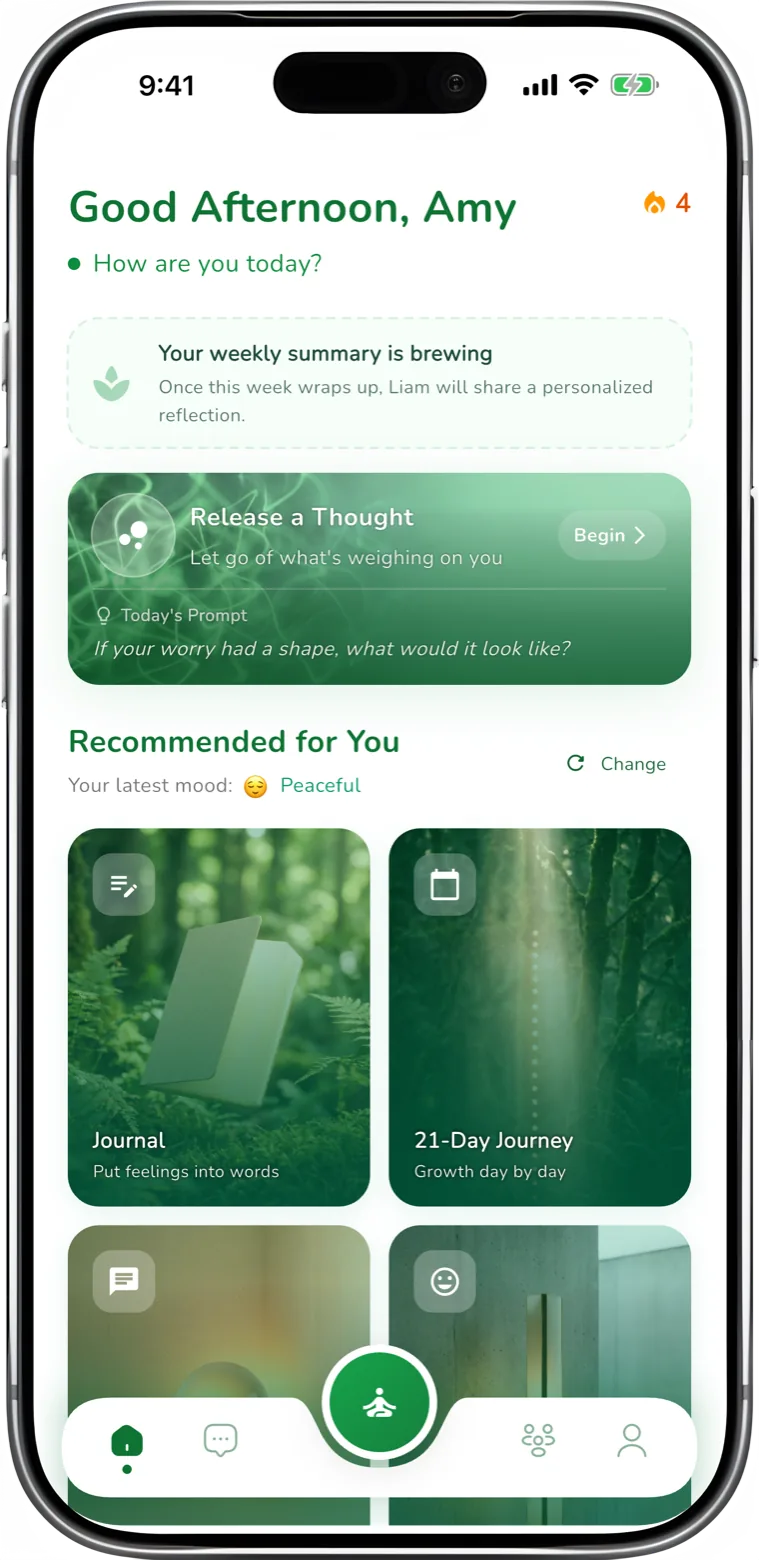
The home screen asks how you are, suggests one technique for right now and keeps the Journal, the 21-Day Journey and Liam one tap away.
What is encrypted, and what is not
Most apps in this category say “your data is encrypted” and leave it there. Here is the actual breakdown. Everything below is protected in transit; the table is about encryption at rest, before the data is written to the database.
| Feature | Encrypted before storage? | What protects it |
|---|---|---|
| Chat messages with Liam | Yes — AES-256 | Encryption plus per-user access rules |
| Chat bookmarks | Yes — AES-256 | Encryption plus per-user access rules |
| Liam’s memory | Yes — AES-256 | Encryption plus per-user access rules |
| Thought Reframe answers | Yes — AES-256 | Encryption plus per-user access rules |
| Gratitude journal | No | Per-user access rules only |
| Achievement journal | No | Per-user access rules only |
| Free flow journal | No | Per-user access rules only |
| Mood entries and notes | No | Per-user access rules only |
| Released thoughts (shared) | No | Anonymous by design, readable by signed-in users for 7 days |
Table scrolls sideways on small screens.
Why we do not say “only you can read it”
The encryption key is derived server-side rather than being held only on your device. That means relif is technically able to decrypt chat messages — for example, in response to a lawful request. A key that only ever existed on your phone would prevent that, and would also mean losing your entire history when you change phones. It is a real trade-off, and we would rather describe it than use language like “zero-knowledge”, “end-to-end” or “your words never leave your device”, none of which would be accurate.
There is a second caveat. If encryption fails when saving a message, the app retries once and then saves it unencrypted rather than losing what you wrote. So “every message is always encrypted” would overstate it too.
Who else sees your data
Your chat messages are sent to OpenAI to generate Liam’s replies — that is how the feature works, and there is no version of it where they are not. relif also uses processors for hosting, subscriptions, email, analytics, attribution and crash reporting; they are named in the privacy policy. We do not sell personal information, and the app has a “do not sell or share” toggle. We do not claim your data is “never shared with third parties”, because a processor list exists and that claim would contradict it.
What you control
- Use relif without an account. Anonymous sign-in on first launch: no email address required. Fewer features, but no identity attached.
- See and delete Liam’s memory. A dedicated screen lists every remembered item and lets you delete them individually — built for the GDPR right to erasure.
- Export your data. A JSON export from inside the app. If any part of the export is truncated, the export records that it was partial rather than presenting itself as complete.
- Delete your account. A server-side deletion job with a per-collection strategy, including cascading removal of shared thoughts and the mapping between them and you, plus erasure requests forwarded to the third parties that hold data.
- Consent controls. Analytics and marketing-measurement consent are separate choices you can change, and health-related information is processed on explicit consent you can withdraw.
Access rules
Every private collection is scoped to your user ID at the database level — conversations, messages, bookmarks, journals, mood entries — with a default-deny rule at the end of the ruleset, so anything not explicitly permitted is refused. Two things are deliberately not private: released thoughts are readable by signed-in users for seven days (that is the point of the shared garden, and they carry no name), and a small number of subscription fields are client-writable so entitlement recovery works after a purchase.
At a glance
- Encrypted at rest
- Chat messages, chat bookmarks, Liam’s memory, Thought Reframe answers
- Not encrypted at rest
- Journals, mood entries and notes, released thoughts
- In transit
- Encrypted
- Key custody
- Derived server-side — not device-only, not zero-knowledge
- Account required
- No — anonymous use is supported
- Data export
- Yes, JSON, from inside the app
- Account deletion
- Yes, server-side, with third-party erasure forwarding
- App lock
- None — there is no biometric app lock, only biometric quick sign-in
What this page will not claim
No “military-grade encryption” — AES-256 is the industry standard and the adjective means nothing. No “100% private and secure” — relif’s own privacy policy says no method is completely secure, and the marketing should match the policy rather than the other way round. No “HIPAA compliant” — HIPAA does not apply to a direct-to-consumer wellness app. No “GDPR certified” — no such certification exists; what we can say is that we process personal data in accordance with the GDPR and that the rights machinery is built and working. And no “biometric lock”: what ships is biometric quick sign-in, not an app lock, and we have stopped saying otherwise.
Common questions
Can relif read my chat messages?
Technically yes, because the encryption key is derived server-side. In normal operation nobody is reading them; the capability exists for lawful requests and for support recovery. We state it rather than implying otherwise.
Are my journal entries encrypted?
Not at rest. Journals and mood entries are protected by per-user access rules but stored in plain text. Chat, bookmarks, Liam’s memory and Thought Reframe answers are the encrypted surfaces.
Can I use relif without giving an email address?
Yes. Anonymous use gives you unlimited breathing, three relief techniques and two messages to Liam. A free account adds mood tracking, the gratitude journal and higher daily allowances.
Does relif have a passcode or Face ID lock?
No. There is biometric quick sign-in, but no lock on the app itself. If you need the content behind a device lock, use your phone’s own screen lock.
What happens when I delete my account?
A server-side job removes your data across collections, cascades the removal of shared thoughts and their author mapping, and forwards erasure requests to the third parties that hold data. Details in the privacy policy.
Keep reading
- Liam, the AI companionWhat Liam remembers, and how to delete it item by item.
- Privacy policyThe full legal document, with processor list and regional rights.
- Crisis support in the appWhat the crisis audit trail records — a hash, not your words.
- About relifThe company, and the rules we hold our own copy to.
Get relif free
Free to download on iOS and Android


Wellness Disclaimer: relif is a wellness and self-care companion designed to support your emotional wellbeing. It is not a medical device, does not provide medical advice, and is not a substitute for professional healthcare, therapy, or counseling. If you are experiencing a medical or mental health emergency, please contact your local emergency services or a crisis helpline immediately.
Editorial policy: Written by the relif team from primary sources — the product itself, store listings and peer-reviewed or official publications. Not medical advice. Read our editorial policy and sources.