Trust
Crisis support: what relif does, and what it cannot do
relif screens messages for crisis language in all eight app languages and routes to a hard-coded registry of verified helplines — never to AI-generated advice. Crisis support is free on every tier, including without an account. It is not a monitoring service and not an emergency service.
Last reviewed:
20+ techniques in one library
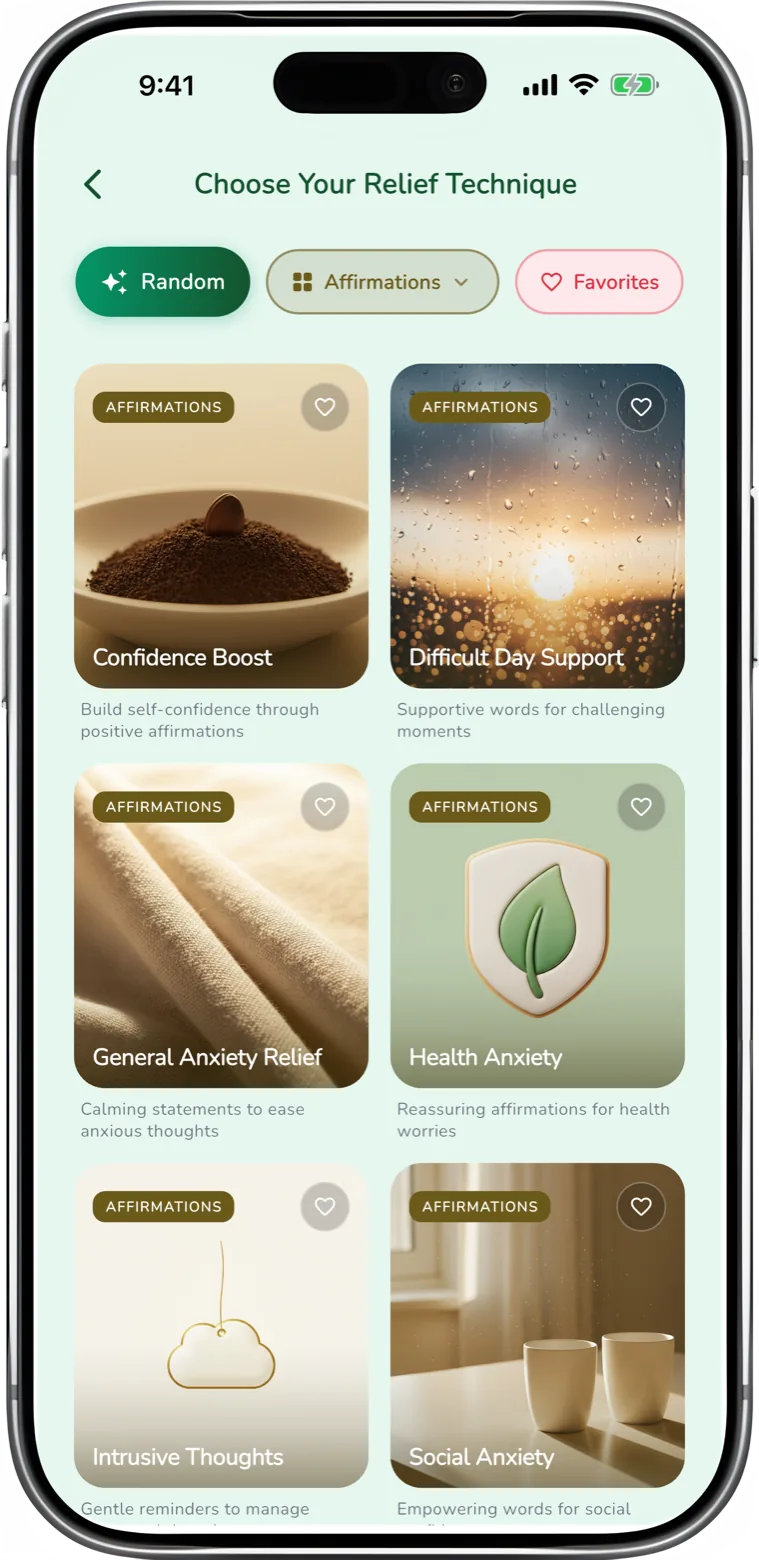
Grounding, breathing, body-based and thought-based techniques, each with a plain-language explanation and a timer.
The limits, first
relif is not an emergency service. It does not monitor you, it cannot call anyone on your behalf, and crisis detection only works when you have an internet connection and are typing into the app. If you are in danger, contact your local emergency services or a crisis line — the numbers are at the foot of this page, and on the crisis protocol page.
We put that first because “24/7 support” is the standard phrasing in this category, and it implies a capability relif does not have.
How detection works
Before Liam generates a reply, your message is screened for crisis language using multi-language keyword matching with negation analysis — so “I’m not going to hurt myself” is not treated as a disclosure. The screening runs in all eight app languages: English, Hebrew, Arabic, German, Spanish, French, Portuguese and Russian.
If it fires, relif surfaces crisis resources. Those resources are never written by the AI. They come from a hard-coded registry of verified helplines covering more than thirty countries, with a fallback to an international helpline directory everywhere else. A language model that hallucinated a phone number in this context would be unacceptable, so it is never given the opportunity.
Design decisions worth knowing
- Crisis screens are lavender, not red. A red alert is the wrong signal to send someone who is already frightened.
- Resources are never paywalled. Crisis detection and helpline routing are available on every tier, including anonymous use with no account.
- The audit trail does not store your words. Crisis-detection events are logged for accountability under California SB 243, but the record contains a SHA-256 hash of the matched keyword plus metadata — never the text of your message.
- A break reminder for minors. A cumulative three-hour timer prompts a break, also built for SB 243.
- Liam is disclosed as AI at all times via a persistent, non-dismissible banner, so nobody in distress can mistake it for a person.
The reply filter
Separately from crisis detection, every reply Liam produces passes a post-generation filter that screens for phone numbers, diagnoses, medication advice, self-harm content and data leaks before it reaches you. If a layer fails, a pre-written locale-aware fallback is shown rather than a generated message. More on the full safety architecture on the Liam page.
At a glance
- Availability
- Every tier, including anonymous — never paywalled
- Languages
- All 8 app languages
- Helpline source
- A hard-coded registry of verified numbers for 30+ countries
- AI involvement
- None — crisis resources are never model-generated
- Audit record
- Hashed keyword and metadata only; never message text
- Minors
- Cumulative 3-hour break reminder
- Requires a connection
- Yes — detection does not work offline
- What it is not
- Not monitoring, not an emergency service, not a clinical assessment
On this website
Every page on this site that discusses anxiety, panic, mood or Liam carries a crisis block with real tel: links, rendered as server-side text: no JavaScript needed, no account, no paywall, and readable by a screen reader. The numbers are locale-routed — a German reader is not shown a US number — and we re-verify them quarterly against each operator’s own site, with the last verification date recorded in the code.
Where we could not verify a number to that standard — several Gulf markets and Russia — we show the local emergency number and an international directory link rather than publish something we cannot stand behind.
Common questions
Will relif call emergency services for me?
No. relif shows you verified numbers and makes them one tap to dial. It never contacts anyone on your behalf, and it does not notify a contact or a service.
Does crisis detection work offline?
No. Detection runs as part of processing a message, which needs a connection. This is precisely why we do not describe relif as always-available crisis support.
Is my message stored when detection fires?
The audit record stores a hash of the matched keyword and metadata, not your message text. Your chat messages themselves are stored encrypted, as described on the privacy page.
Do I need to pay for crisis support?
No. It is on every tier, including anonymous use, and it will never be behind a paywall or a sign-up wall.
Keep reading
- Liam, the AI companionThe five safety layers around the model, and what Liam will not do.
- Crisis protocolThe full published protocol, per country.
- Privacy and security in relifWhat the crisis audit trail stores — and what it does not.
- Panic attacks: what people do in the momentFor an acute but non-emergency moment.
Get relif free
Free to download on iOS and Android


Wellness Disclaimer: relif is a wellness and self-care companion designed to support your emotional wellbeing. It is not a medical device, does not provide medical advice, and is not a substitute for professional healthcare, therapy, or counseling. If you are experiencing a medical or mental health emergency, please contact your local emergency services or a crisis helpline immediately.
Editorial policy: Written by the relif team from primary sources — the product itself, store listings and peer-reviewed or official publications. Not medical advice. Read our editorial policy and sources.